
Fertilizer application services — from 400 ha
We apply solid mineral fertilizers, organic fertilizers and liquid UAN with our own machinery and operator. Spreading with automatic rate weighing, working width up to 54 metres. Western and central Ukraine, payment per worked hectare.
General information
A 10,000-litre spreader with a weighing system pays off from several thousand hectares per season. If you have 500 or 1,500, it is cheaper to order the work than to keep machinery that works two weeks a year and stands idle the rest of the time.
You have a spreader, but no weighing
Then the actual rate is known only roughly. On a thousand hectares, the difference between “we applied 300 kg/ha” and “we thought we did” adds up to tens of tonnes of fertilizer — one way or the other.
The window closes faster than you can keep up
Peak days when the whole area has to be covered within a week. We come in with a second machine alongside yours or cover the whole volume ourselves — whatever you need.
How application works
From request to certificate of completed work — five steps. The fertilizer and rate are agreed before we go out, not in the field.
Request and input data
Crop, area, type of fertilizer and rate. By phone, in Telegram or through the form.
Agreement before we go out
Where the fertilizer is stored, how we load it, how to access the field. We fix the rate per hectare or per tonne.
Setup on site
The machine weighs the first hopper load and sets the rate and working width for the actual granules. We check the overlap on the first run.
Work
The operator sees the rate and remaining amount on the terminal throughout the pass. HeadlandControl switches on automatically at the headlands.
Certificate of completed work
Actual hectares and actual fertilizer used, from the terminal. Payment for the hectares in the certificate.
Actual hectares and actual fertilizer used are taken from the terminal — and go into the certificate.
What we apply and with what
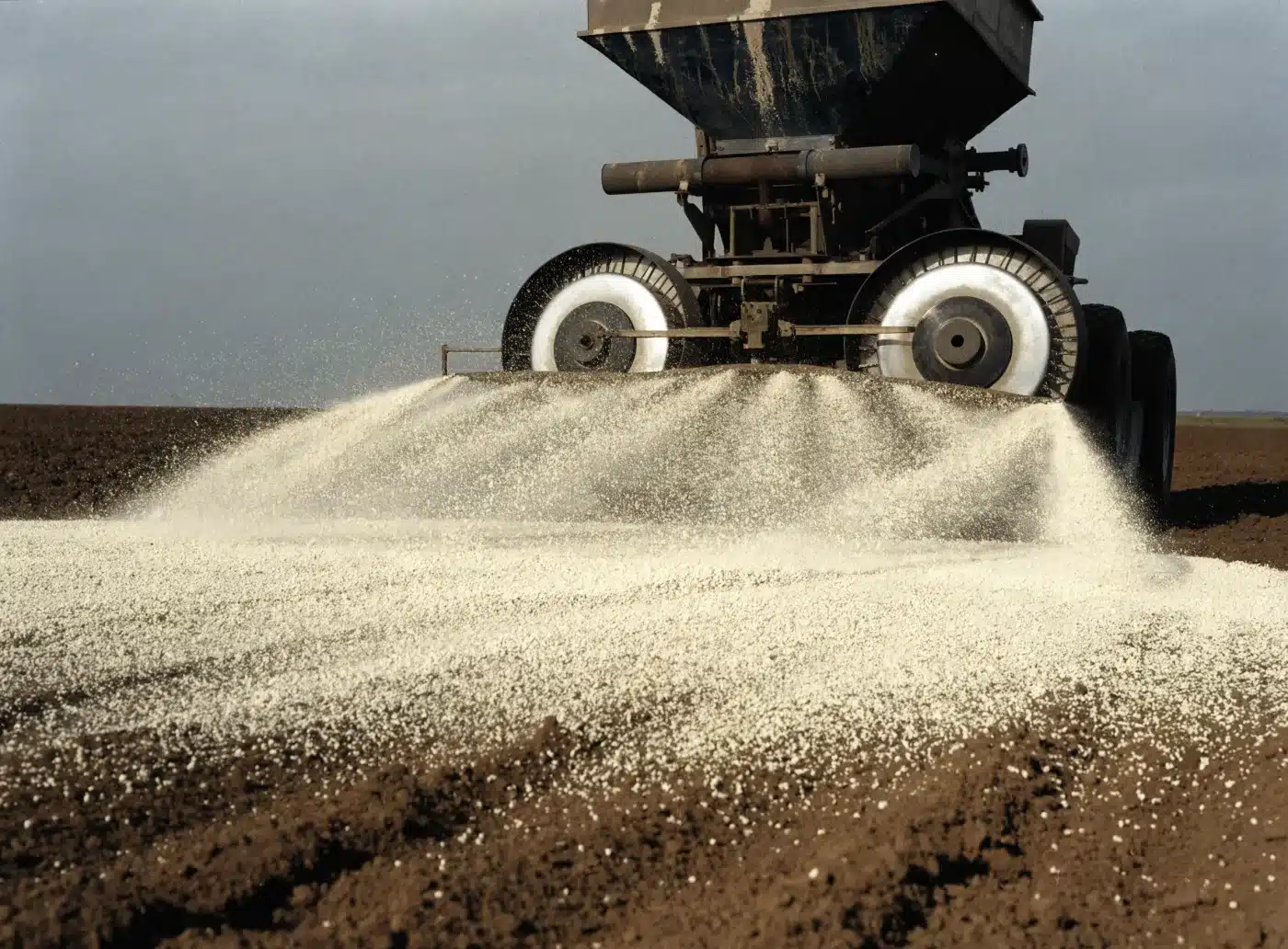
Solid mineral fertilizers
Ammonium nitrate, urea, NPK, ammonium sulphate — basal application before tillage and top-dressing during the season.
We work with an Amazone ZG-TS 10001 trailed spreader with a 10,000-litre hopper. The rate is set on the terminal and held automatically: the machine weighs the remaining load throughout the pass and adjusts the feed itself.
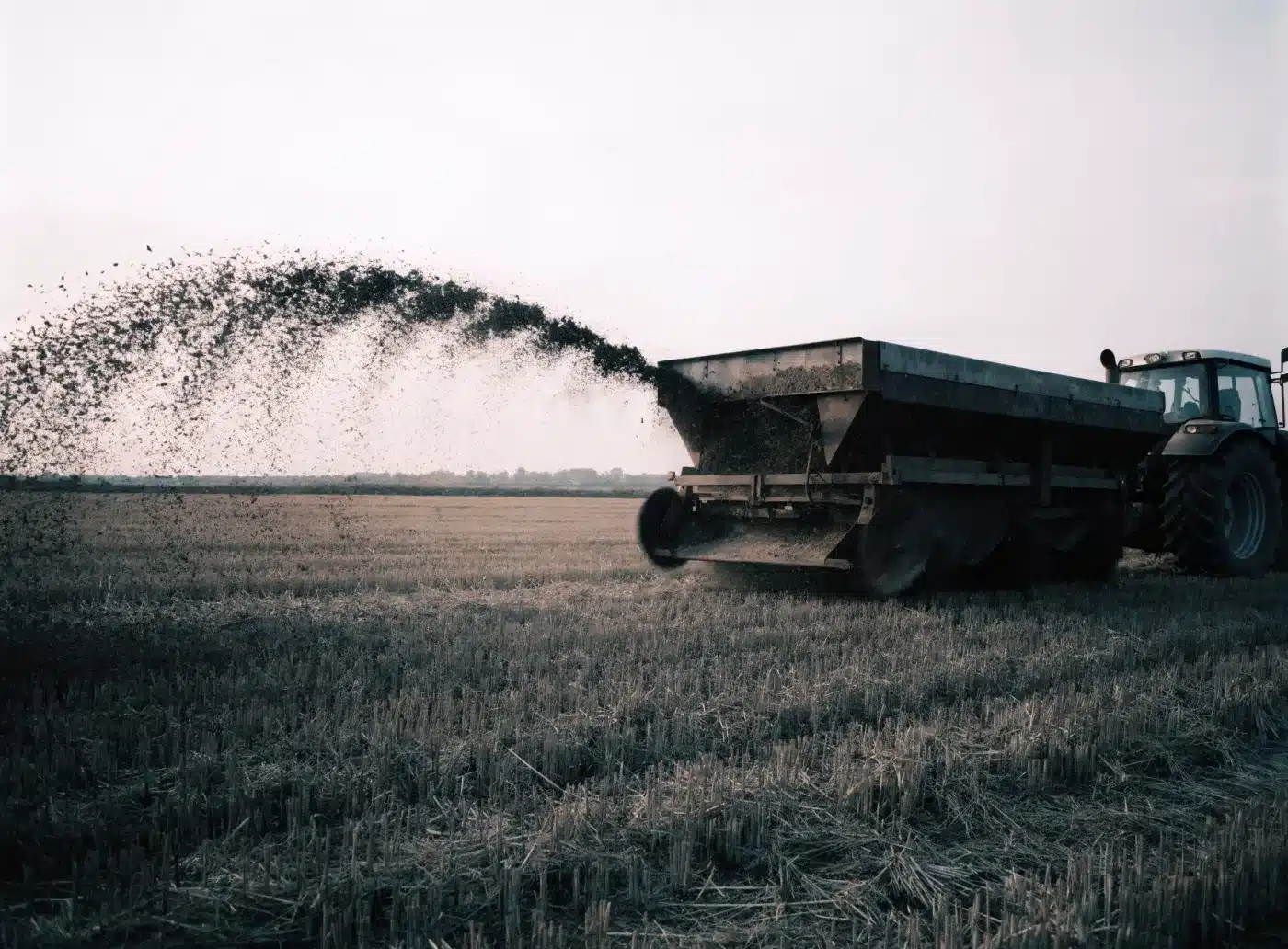
Organic fertilizers, manure and lime
Manure, compost, sugar-factory lime, limestone flour — what is applied after harvest or before primary tillage.
The machine is an Annaburger HTS 21H.04 with 15 m³. Here it is not the spreading width that matters but logistics: output is set by the distance from the heap to the field, not by the machine itself.
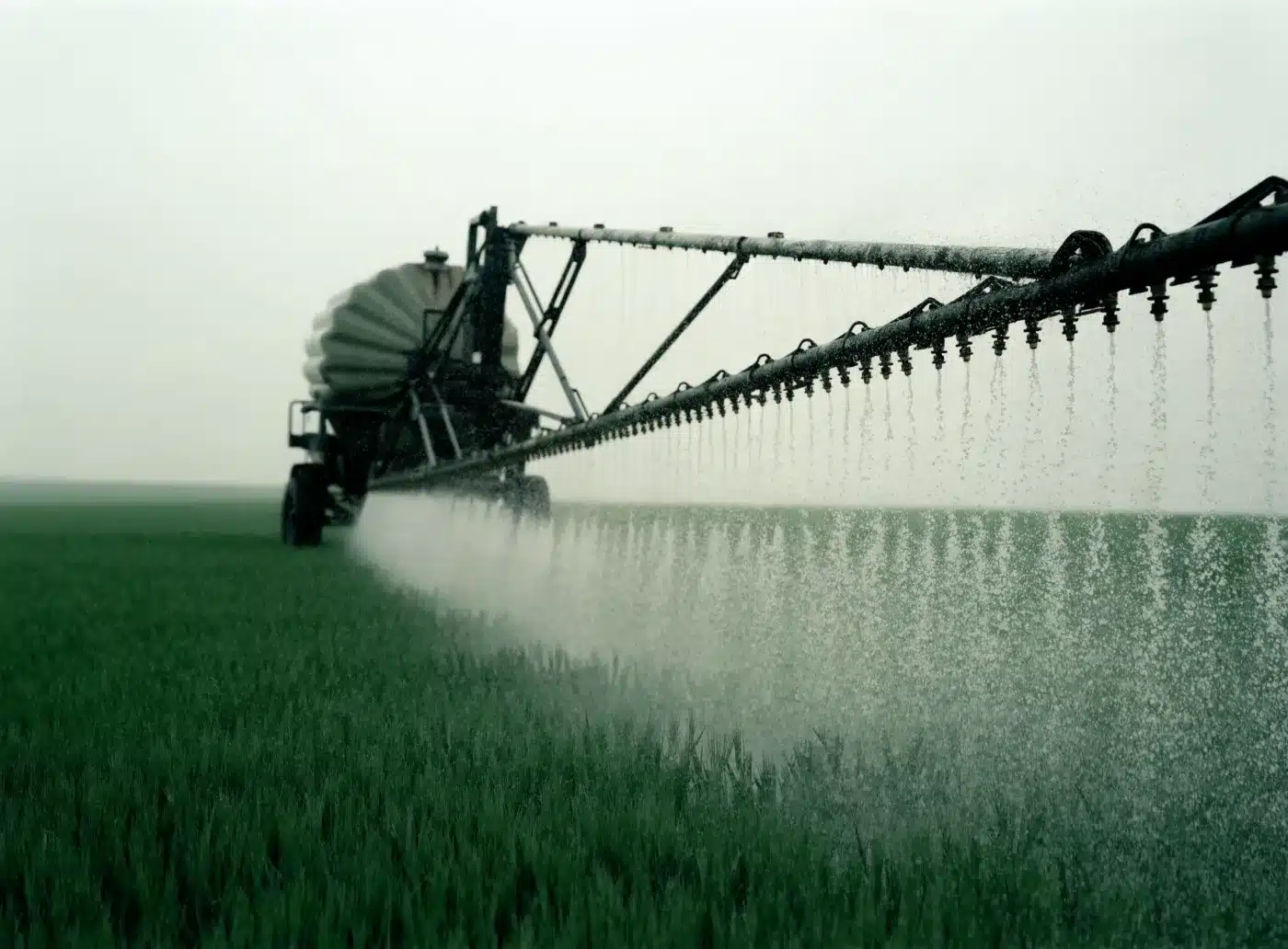
Liquid fertilizers and foliar feeding
UAN, urea solution, micronutrients, sulphur. Applied with the same self-propelled sprayers we use for crop protection.
Feeding often goes in one tank mix with a fungicide — one less pass over the field and one less round of soil compaction.
Machinery we work with
Our own fleet, no middlemen. Every machine has its own operator.
Main machine · 3 systems
Amazone ZG-TS 10001 — our main machine for mineral fertilizers
A trailed spreader with a 10,000-litre hopper and a working width from 15 to 54 metres. Feed rate up to 650 kg/min. Three systems that make the fertilizer land evenly:
ProfisPro — weighing instead of a calibration test
The hopper sits on load cells: the machine knows the actual mass of the remaining load at every moment and compares it with how much it should have spread on the area covered. The rate is calibrated from the first metres of the pass, not from a test done in the yard last week. This matters — the bulk density of the same ammonium nitrate varies from batch to batch and with air humidity.
HeadlandControl — field edge without a double dose
On the headland the discs switch to one-sided spreading with a changed trajectory. Fertilizer doesn’t fly beyond the field edge or land in a double layer on the last twenty metres of the run.
WindControl — real-time wind correction
A sensor measures wind speed and direction, and the system adjusts disc speed and the feed point. The working window gets wider, but not without limits. Amazone ZG-TS 10001 in the catalog.
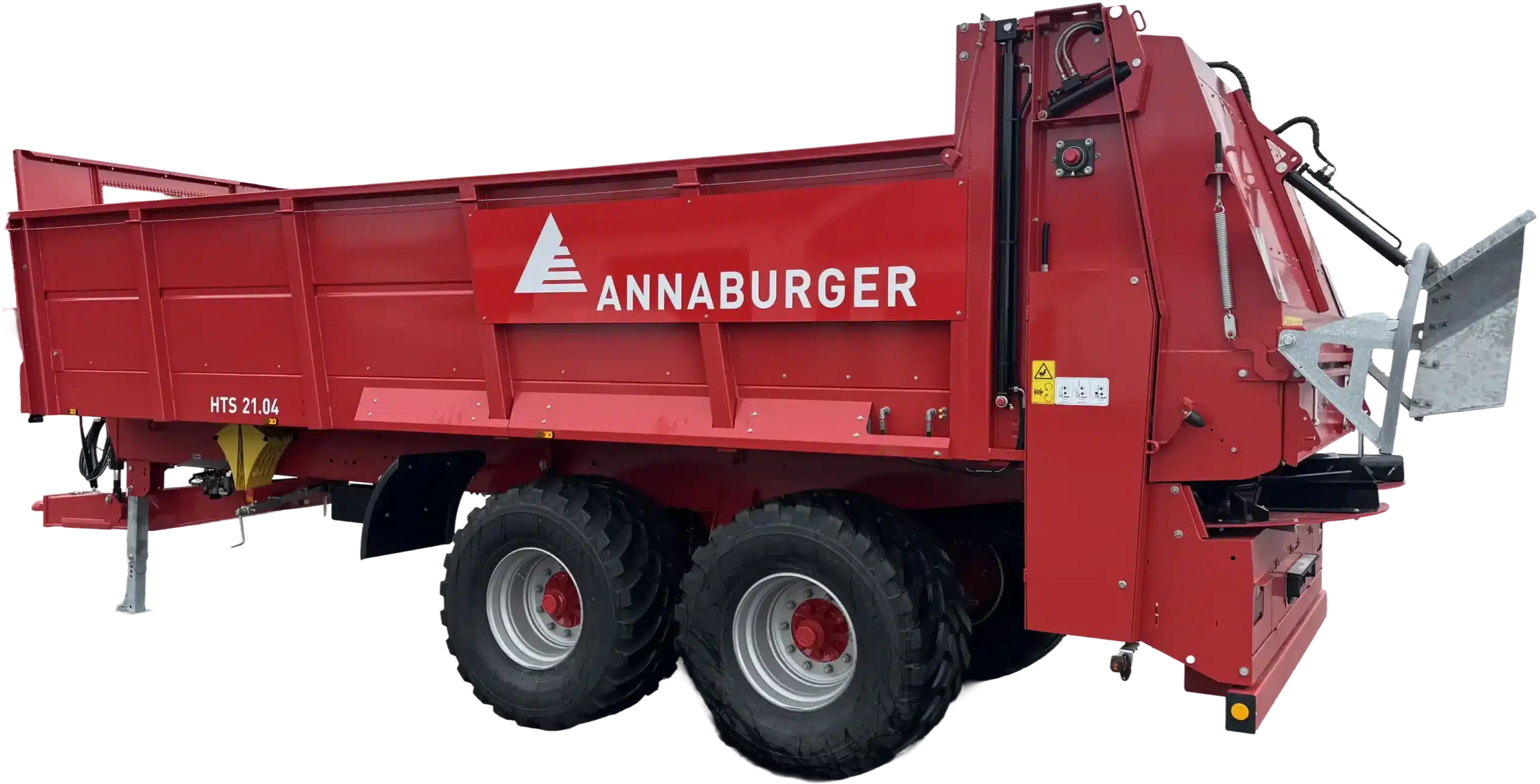
Organic · 15 m³
Annaburger HTS 21H.04 — manure, compost, lime
15 m³ body, spreading width up to 20 m. Dosing via a hydraulic tailgate and a scraper floor.
Reinforced spreading discs handle both dry compost and heavy bedding manure. Requires a tractor of 180 hp or more.
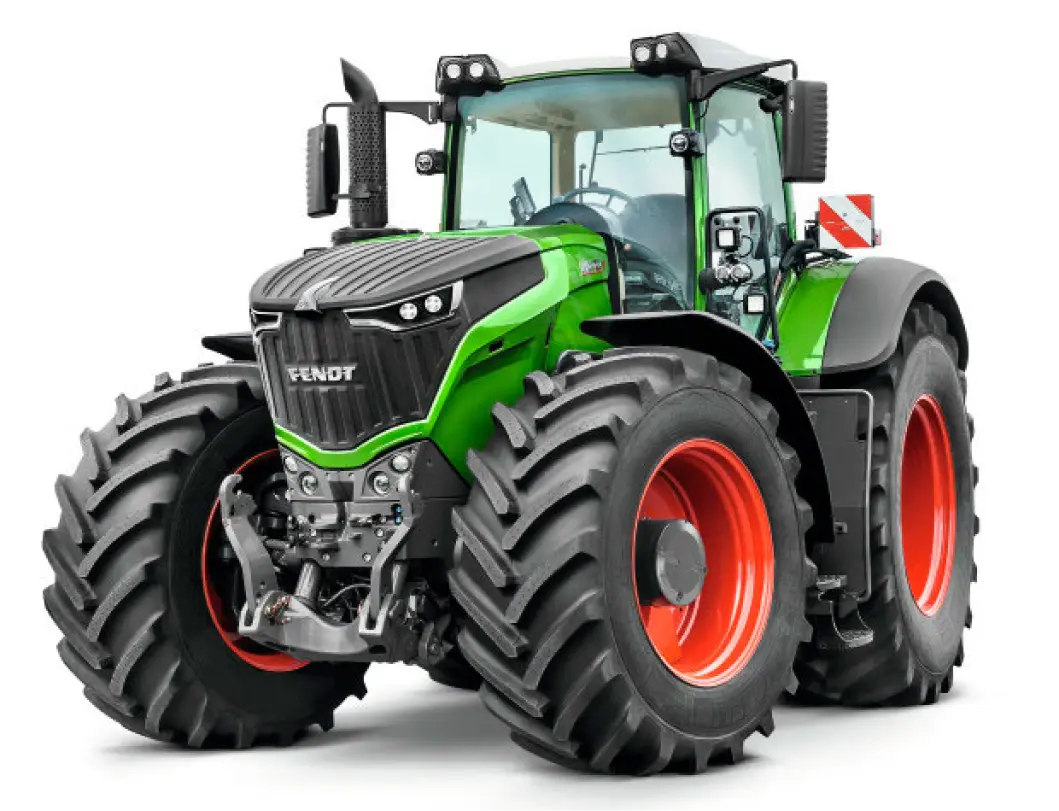
Power · 5 tractors
Tractors for trailed machines
Fendt Vario 1050 and 1038, Massey Ferguson 8737 and 8690, Valtra T234.
Having our own tractors means we don’t look for a tractor for the spreader in the middle of the season and don’t depend on someone else’s schedule.
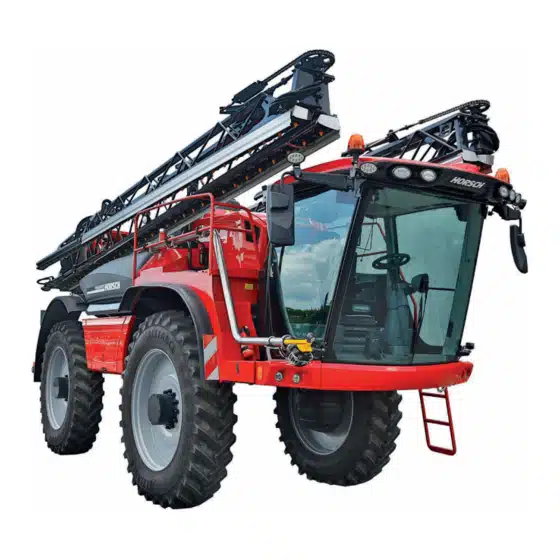
Liquid · UAN and foliar
Self-propelled sprayers for liquid fertilizers
New Holland SP310F, Case Patriot 4430, 3330 and 3230, Horsch Leeb 6.280VL. Boom from 30.5 to 41 metres.
We use them to apply UAN and foliar feeds too — no separate machine for liquid fertilizers is needed.
How much we cover per shift
Calculated from working width and speed with a field efficiency factor that accounts for turns and refills.
A separate note on organic fertilizer. A 15 m³ body holds roughly 11–12 tonnes of manure. At 30 t/ha one trip covers less than half a hectare. So output here is set not by the machine but by the distance from the heap to the field: a heap at the field edge changes the timeline more than any machinery.
Calculate your fertilizer need and number of refills
Enter the area, rate and fertilizer type — we will show how many tonnes you need, how many times the hopper has to be refilled and how many shifts it will take.
Calculated for an Amazone ZG-TS 10001 with a 10,000-litre hopper and a 30 m working width. A reference bulk density is used — the actual density of your batch will differ, which is exactly why the machine weighs the remaining load instead of trusting a table.
If the figures match your plan, leave a request and we will calculate the cost for these specific hectares. If not, write to us anyway — we will find a different schedule.
Why uneven spreading eats into your yield
No spreader spreads perfectly evenly. The only question is how uneven it is — measured by the coefficient of variation.
Three things that raise the coefficient of variation fastest:
- Inaccurate rate. A spreader without scales delivers the rate it was once calibrated for. The actual bulk density of the batch and air humidity change the feed by 5–15%.
- Overlap between passes. The spread pattern is triangular: there is less fertilizer at the edge of the strip than in the centre. Passes must overlap exactly enough for the edges to add up to an even rate. A 3-metre error at a 36-metre width already means stripes.
- Headland strip. Without HeadlandControl the last 20 metres of every run get a double dose, and the field edge itself gets half.
An overfed strip doesn’t give a yield increase that would pay for the extra fertilizer. An underfed one won’t give a yield at all. At 300 kg/ha the difference between even and uneven spreading adds up to tonnes of fertilizer for every 500 hectares.
What to prepare before we arrive
Five points that let the spreader go out into the field straight away instead of waiting half a day.
A full checklist for preparing the field, access roads and logistics is in the article “How to prepare a field for a contractor’s machinery”.
- Fertilizer on site — in a store next to the field or in heaps at the edge. Fertilizer is supplied by the client.
- A loader with an operator — telescopic or front loader. A 10,000-litre hopper can't be filled by hand.
- Access and a loading area — a hard surface for loading, with room for a trailed machine to turn.
- Field map or boundaries — so that HeadlandControl and autosteer work along the actual outline, not by eye.
- A person who accepts the work — in the field and signs the certificate.
If you don’t have a loader, tell us in advance: we will bring our own or adjust the schedule to yours.
Why Wester

Our own fleet, not middlemen
Amazone, Annaburger, self-propelled sprayers and tractors for them. You know what will arrive in your field before you sign anything

The operator is part of the service
This is not bare rental: the machine arrives with a person who knows how to work with it

Rate from the scales, not from a test
Actual usage is recorded from the terminal and goes into the certificate — you pay for what actually landed on the field

We cover 9 regions
Western and central Ukraine — Khmelnytskyi, Vinnytsia, Ternopil, Rivne, Volyn, Lviv, Ivano-Frankivsk, Chernivtsi and Zhytomyr regions.
How much fertilizer application costs per hectare
There is no single price per hectare — it depends on several factors:
- Type of fertilizer. Solid mineral, organic and liquid UAN are charged differently: the first per hectare, organic more often per tonne.
- Application rate. 150 kg/ha and 400 kg/ha mean a different number of refills for the same area.
- Fertilizer logistics. Where the fertilizer is stored and whether there is something to load it with. The most underestimated factor: a distant store costs more time than the spreading itself.
- Area and shape of the fields. One 500 ha field costs less than five 100 ha fields: fewer turns and moves.
- Timing. Work in a narrow agronomic window costs differently from work planned in advance.
Tell us the crop, area, fertilizer type and rate — we will calculate it for your specific hectares and give you a figure.
Who our clients are
We don’t take every request — machinery and operators are booked for the season in advance. Here is who we work with.
400+
hectares of cultivated area
The minimum scale at which our format pays off for both sides.
9
regions in our service area
Western and central Ukraine — moving the machinery doesn’t eat into the cost of work.

Less than 400 ha? Team up with your neighbours
If several farms nearby put together a combined area of 400+ ha, we come out to the field. One contract, each farm pays for its own hectares.
Questions and answers
Here is what farmers ask most often before their first application with us — about fertilizers, loading and spreading width.
No, the fertilizer is supplied by the client, with documents. The price includes the machine, operator, fuel and transport to the field.
Usually the client — a telescopic or front loader with an operator is needed. A 10,000-litre hopper can’t be filled by hand. If you don’t have a loader, tell us in advance: we will bring our own.
Amazone’s rated 54 metres is achieved with dense, uniform granules. With ordinary ammonium nitrate or urea the working width is 24–30 metres. We set it for the actual batch, not for the spec sheet.
The Amazone ZG-TS 10001 at 200 kg/ha covers about 300–350 ha per 10-hour shift if the loader is nearby. Organic fertilizer is counted not in hectares but in tonnes and trips: here everything depends on the distance to the heap.
Yes, if the products are compatible. This saves one pass over the field, which means less soil compaction and lower costs.
400 hectares. If you have less, team up with neighbouring farms: one contract, each pays for its own hectares.
Yes, we work in nine regions of western and central Ukraine. Transport is included in the quote — so the further away the field, the more the volume of work matters.