In short: double treatment on overlaps eats up from 4–6% of the crop protection budget on regularly shaped fields to 20% on fields with complex geometry. On small farms overuse reaches 30%.
with a protection budget of $80/ha and an area of 1,000 ha
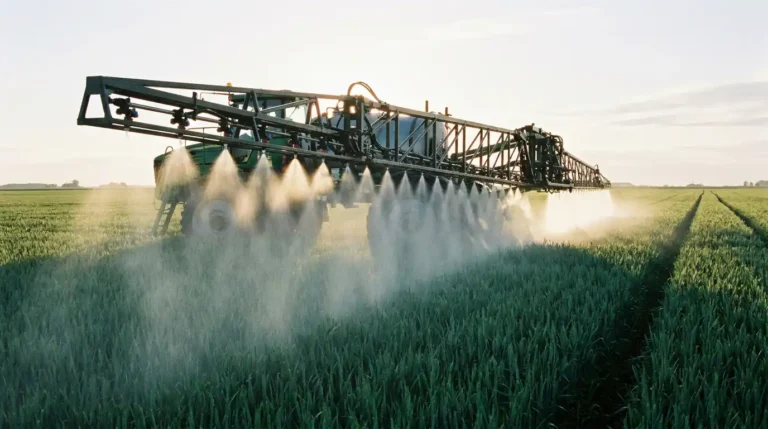
The problem with application rates is that the recorded rate and the rate actually applied are two different numbers. Between them stand field geometry, boom settings, pressure, speed and nozzle wear. Let's look at each.
Where overlaps come from
Overlaps are areas the sprayer passes over twice. The main sources:
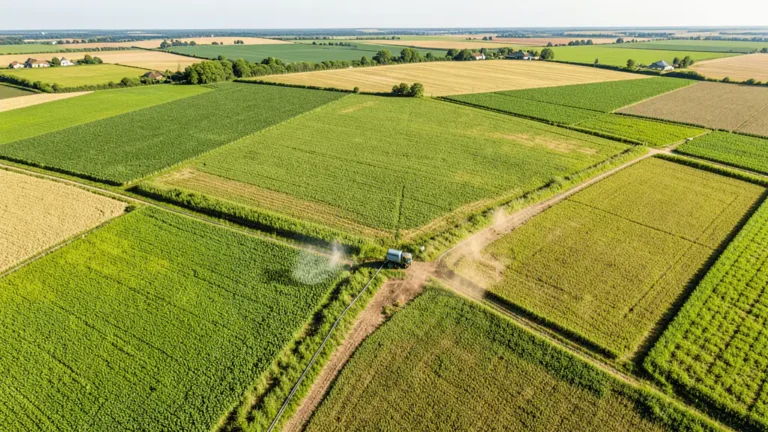
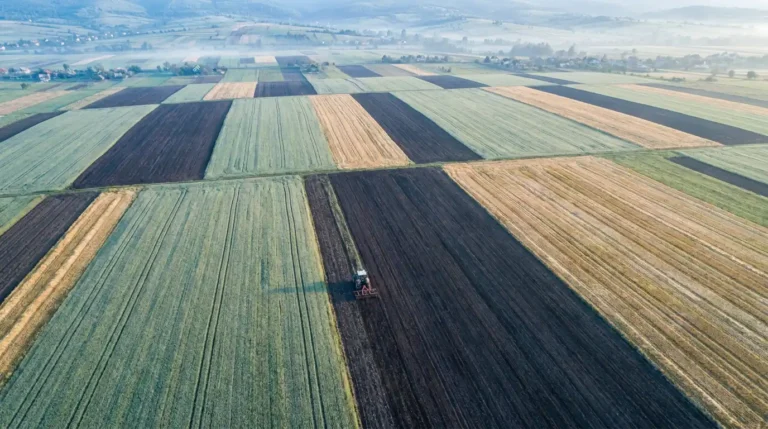
- Wedge-shaped fields and irregular outlines. Every partial pass along a slanted boundary is a strip with a double dose. A real case: on a 73 ha rapeseed field a double dose was applied to 4.1 ha, that is 5.6% of the area.
- Headlands. The classic zone of triple treatment if sections don't switch off automatically.
- Manual driving without GPS. The operator overlaps by a margin of 0.5–1 m — that's 2–4% of the working width on every pass.
- Obstacles in the field. Driving around pylons, poles, trees and holes creates overlapping passes.
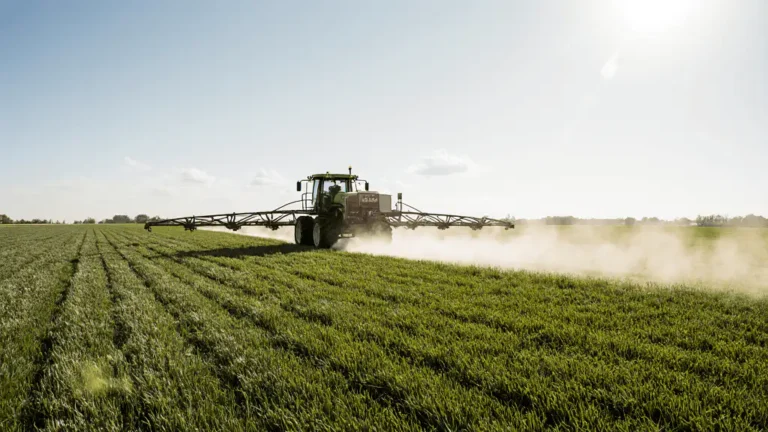
- The difference between actual and nominal working width because of varying boom height above the crop.
How much overlap costs
Calculation for an area of 1,000 ha with different crop protection budgets:
| Overlap | Products $60/ha | Products $80/ha | Products $120/ha |
|---|---|---|---|
| 5 % regularly shaped field | 133k UAH | 178k UAH | 267k UAH |
| 8 % typical field with obstacles | 213k UAH | 285k UAH | 427k UAH |
| 12 % complex geometry | 320k UAH | 427k UAH | 640k UAH |
| 20 % small fields, manual driving | 534k UAH | 711k UAH | 1,067k UAH |
National Bank rate of 44.46 UAH/$ on 09.09.2026. The calculation doesn't include fuel overconsumption and the extra working time of the machine.
The other side: misses are more dangerous than overuse
Overlaps mean lost money. Misses mean lost yield and, worse, the development of resistance: on a strip with an underdose, the weed or pathogen population receives a sublethal load and is selected for resistance.
Misses arise for the same reasons as overlaps: boom sway, clogged nozzles, sections at different heights.
Spray volume: what it depends on
| Type of treatment | Spray volume, L/ha | Optimal droplet size |
|---|---|---|
| Non-selective herbicides | 150–200 | coarse droplet, anti-drift |
| Soil-applied herbicides | 200–300 | coarse droplet |
| Systemic post-emergence herbicides | 100–200 | medium |
| Contact fungicides | 200–300 | 250–350 µm |
| Insecticides | 150–250 | medium — fine |
| Foliar feeding | 200–300 | coarse droplet |
Droplets finer than 150 µm drift in the wind already at 3–4 m/s.
A formula that checks the setup in one minute
Output of one nozzle:
| Rate, L/ha | Speed, km/h | Nozzle spacing | Required output, L/min |
|---|---|---|---|
| 150 | 8 | 0.5 m | 1,00 |
| 200 | 8 | 0.5 m | 1,33 |
| 200 | 10 | 0.5 m | 1,67 |
| 100 | 12 | 0.5 m | 1,00 |
The reverse formula for checking the actual rate:
Pressure: a mistake that costs 30–40% of the product
The most common mistake in the field is setting 3 bar instead of the recommended 2, “for better coverage”.
- output increases by 30–40 % — instead of 200 L/ha you get about 270 L/ha;
- the spray pattern turns into a fine mist that drifts in the wind instead of settling on the crop.
Pressure and rate are related non-linearly: to double the output you have to quadruple the pressure. That's why the rate is adjusted by changing nozzles, not pressure.
Calibrating a sprayer: 30 minutes that pay off on a single field
-
01Check the nozzles
Collect water from each one for 1 minute at working pressure. A deviation of more than 10% from nominal — replace the nozzle.
-
02Set the boom height
A height difference between sections of even 10–15 cm changes the zone where spray patterns overlap.
-
03Check for play
Play of more than 5 mm at the boom mounting points causes sway at working speed.
-
04Measure the real speed
Not by the speedometer: 100 m with a stopwatch at working revs with the tank 50% full.
-
05Do a test run with water
Fill a known volume, treat a known area and compare the actual rate with the calculated one.
-
06Check the filters and pressure gauge
A clogged filter lowers the pressure at the boom, and a faulty gauge makes all the previous settings meaningless.
What section control gives you
Automatic GPS section shut-off is the fastest way to remove overlaps.
For a farm with 1,000 ha and a protection budget of $80/ha even a minimal 5% is about 178k UAH a year.
Checklist before going out into the field
- Is the wind speed measured on site and not above 3–4 m/s?
- Does the pressure match the nozzle specification rather than “by eye”?
- Have the nozzles been checked for output, with deviation within 10%?
- Is the boom height the same across all sections?
- Has the real speed been measured rather than taken from the speedometer?
- Has the spray volume been recalculated for the actual speed?
- Is section control on and are the field boundaries loaded?
- Has the product mixing order been followed?
- Do the crop stage and temperature match the product's label?
Frequently asked questions
What percentage of crop protection products is lost on overlaps?
On regularly shaped fields — 4–6%, on fields with complex geometry — up to 20%. For small farms with small, irregular fields overuse can reach 30%.
How do you calculate the spray volume?
Output of one nozzle in L/min = rate (L/ha) × speed (km/h) × nozzle spacing (m) ÷ 600.
Why can't the rate be adjusted with pressure?
The relationship is non-linear: to double the output you have to raise the pressure roughly fourfold. The rate is changed by choosing nozzles.
At what wind speed can you spray?
The working guide is up to 3–4 m/s. Droplets finer than 150 µm drift already at this speed.
When should nozzles be replaced?
When the actual output of any nozzle deviates from nominal by more than 10%.
Spraying with parameters recorded
WESTER carries out field spraying and fertilizer application with machinery equipped with GPS navigation and section control — providing the client with maps of completed work and the actual application parameters.
Planning crop protection for the season? See the field work calendar for the western regions and leave a request.