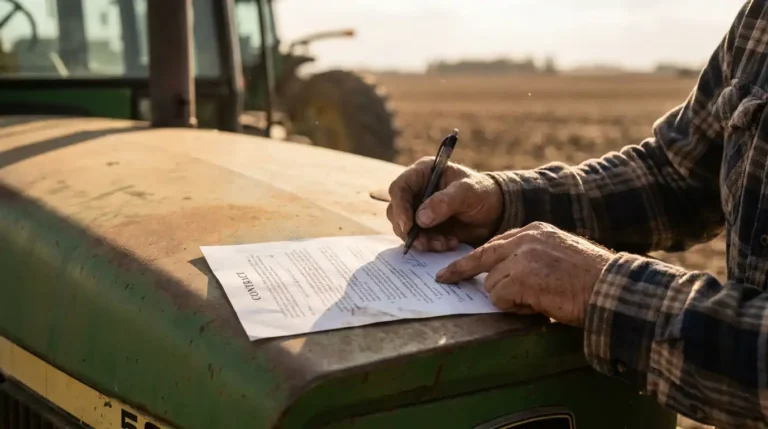
Most disputes between a farm and a contractor arise not from bad faith but from two lines that are simply missing from the contract: how the area is measured and what counts as completed work. Everything else follows from these.
Below is a 14-point checklist worth going through before signing. It is equally useful to the client and the contractor: a clear contract removes 90% of the reasons for conflict in the peak season, when there is neither the time nor the desire to sort things out.
Subject of the contract: not “tillage” but a specific operation
The wording “soil tillage services” means nothing. The subject must include:
- the name of the operation (disking / deep loosening / ploughing / cultivation);
- depth in centimetres with a tolerance (for example, 35 cm ±3 cm);
- number of passes;
- for sowing — seeding rate, row spacing, seeding depth;
- for spraying — spray volume in L/ha, nozzle type, maximum permitted wind speed;
- for fertilizer application — rate in kg/ha and permitted unevenness of distribution.
Without figures you won't be able to prove that the work was done badly — because there will be nothing to compare it with.
Area: the most expensive clause in the contract
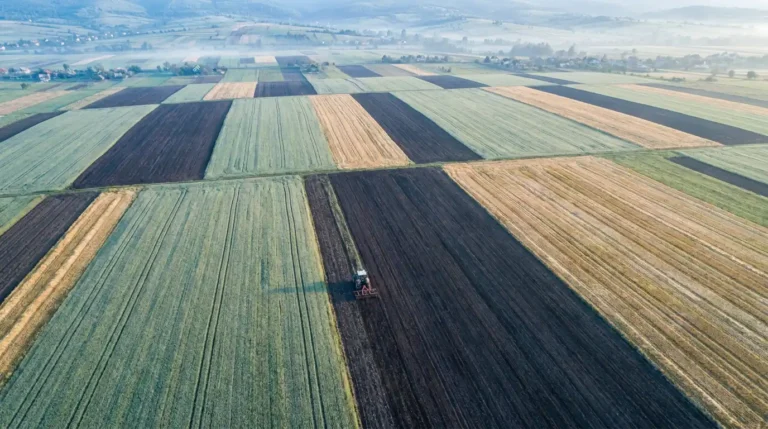
Three different area figures for the same field can differ by 3–8%:
- the area according to the state title / land registry extract;
- the GPS outline area;
- the area actually worked according to the on-board computer.
On 500 ha a 5% difference is 25 ha, or tens of thousands of hryvnias for a single operation. The contract must state explicitly which data source is the basis for payment and who provides it. Ideally — the contractor's on-board system data, with the client's right to receive the export.
Separately specify whether headlands, roads, shelterbelts and unusable land are included in the area.
Price: fixed or linked to fuel
Under Article 843 of the Civil Code, the price of work may be set in the contract or in a cost estimate. For field work it is critically important to fix not just the amount but also the mechanism:
- Settlement currency. A price in $/ha converted at the National Bank rate on the date of the certificate — and the client must understand the currency risk.
- Link to the diesel price. If the contract has an indexation formula, check the base fuel price and the trigger threshold.
- VAT. A price “including VAT” and “excluding VAT” differs by 20%. This is the most common reason for mismatched expectations.
- What the price includes: moves between fields, transport of machinery from the base, downtime caused by the client.
If you haven't yet calculated your own cost for comparison, start with the calculation of the cost per hectare with your own machinery . Without this figure it's impossible to judge whether the contractor's offer is reasonable.
Timing: agronomic windows, not calendar days
Article 846 of the Civil Code allows initial, final and interim deadlines to be set. In agriculture the wording “within 30 days of signing” makes no sense — it protects no one.
“The work is carried out between ___ and ___ provided the field is workable;; the client notifies that the field is ready ___ days in advance.”
Plus, separately, the maximum time to complete after a call-out, for example, 3 working days.
This is especially critical for operations with a narrow window: sowing winter crops, soil-applied herbicides, desiccation. Approximate dates by region are in the field work calendar for the western regions.
Who bears the risk of weather downtime
A clause missing from 80% of contracts. Describe three situations separately:
- the machinery arrived but the field is unworkable because of rain — who pays for the move and the downtime;
- the field is workable but the machinery isn't there — what the consequences are for the contractor;
- work is interrupted in the middle of a field because of a change in the weather — how the partly completed volume is recorded.
Quality and acceptance procedure
Describe a mechanism rather than an evaluative “proper quality”:
- control measurements — how many points per field, by whom and when they are taken;
- permitted deviations in depth, seeding rate and spray volume;
- the period within which the client must make a claim;
- what is done when defects are found — rework, a price reduction or compensation.
Important: under Article 863 of the Civil Code, the limitation period for claims regarding improper quality of work is one year from the day the work is accepted.
Materials: whose seed, fertilizers and crop protection products
The most contentious area after the area itself. Fix:
- who supplies the materials and in what quantity;
- how usage is recorded and what happens to leftovers;
- who is responsible for the result if a product didn't work: the contractor is responsible for application, the manufacturer — for efficacy;
- the permitted process loss — usually 1–3%.
Fuel
Two options — a turnkey price or the client's fuel. The second seems cheaper but requires separate clauses: consumption rate in L/ha, refuelling procedure, liability for overconsumption, record-keeping. Without a L/ha standard the client's fuel becomes an uncontrolled cost item.
Liability for damage
- drainage systems, irrigation channels, water lines and underground utilities;
- damage to adjacent crops;
- crop protection drift onto neighbouring fields with weather conditions recorded;
- damage to machinery from hidden objects in the soil.
Penalties — always mutual
A contract in which penalties apply to only one party is not a contract but a declaration. A balanced option:
- contractor — a penalty for missing the agreed work window;
- client — a penalty for late payment and compensation for a wasted trip;
- a cap on total penalties, for example no more than 10% of the cost of the work.
Payment procedure and schedule
Describe the size of the advance, the deadline for final payment from the date of the certificate, the possibility of paying in produce and the consequences of late payment. For seasonal work a common and workable option is a 30–50% advance and the rest within 5–10 banking days after signing the certificate.
Priority in the peak season
The clause that saves the season. In April and the second half of September there physically isn't enough machinery on the market. If the contract has no fixed place in the queue or reserved window, your field gets worked after those who wrote it in.
“The contractor reserves for the client the period from ___ to ___ and does not accept obligations for this period that would make performance impossible.”
Technical requirements for the machinery
If quality matters to you, not just the fact of a pass:
- tractor class and power, implement model;
- GPS navigation and section control on the sprayer — this directly affects overuse of crop protection products on overlaps;
- telemetry and the client's right to receive track files and maps of completed work;
- condition of wear parts.
Formalities that are remembered last
- form of contract — a works contract or a services agreement;
- the signatory's authority and an up-to-date extract from the Unified State Register;
- the contractor's tax system and VAT payer status;
- document exchange procedure, including electronic document management;
- force majeure with a clear list and confirmation procedure;
- jurisdiction and dispute resolution procedure.
Checklist before signing
- Is the operation described with depth/rate and tolerance?
- Does it state which data source the area is calculated from?
- Is it clear what happens with headlands and unusable land?
- Is the price with or without VAT? Are the currency and exchange rate fixed?
- Is there a mechanism for revising the price if diesel prices change?
- Is timing tied to agronomic windows rather than calendar days?
- Does it describe who pays for weather downtime?
- Is there a procedure for control measurements and a deadline for claims?
- Does it define who supplies materials and who is responsible for the result?
- Is a fuel consumption rate fixed?
- Is liability for damage to drainage and crop protection drift set out?
- Are penalties mutual and capped?
- Is a work window reserved for the peak period?
- Does the client have the right to track files and maps of completed work?
This material is for information only and is not legal advice. Before signing a contract, it's worth getting an assessment from a lawyer who works with your specific situation.
Frequently asked questions
Which contract should be used for field work — a works contract or a services agreement?
Both are used in practice. A works contract (Article 837 of the Civil Code) implies a tangible result handed over to the client, and it is the one more often used for mechanised work. A services agreement (Article 901 of the Civil Code) describes a service that is consumed as it is performed. What matters is not the name but the completeness of the essential terms: subject, area, price, timing, acceptance procedure.
What if the area in the certificate is larger than in the state title?
That's a normal situation: the area actually worked includes headlands and overlaps. A problem arises only if the contract doesn't state the data source.
How much time is there to make a claim about the quality of work?
Under Article 863 of the Civil Code, the limitation period for claims regarding improper quality of work is one year from the day the client accepts the work.
Can the price be linked to the dollar exchange rate?
Yes. Payments in Ukraine are made in hryvnias, but the parties may set the monetary equivalent of the obligation in a foreign currency.
Who is responsible if a product didn't work?
The contractor is responsible for following the application technology — spray volume, speed, pressure, weather conditions and no missed strips. The manufacturer or supplier is responsible for the biological efficacy of the product.
We work under a transparent contract
WESTER carries out the full cycle of field work — soil tillage, sowing, spraying, fertilizer application and harvesting — in 9 regions of western and central Ukraine, with areas and work parameters recorded by on-board systems.
Send us your area, the list of work and your location — we'll prepare a quote and a draft contract with every point from this checklist.