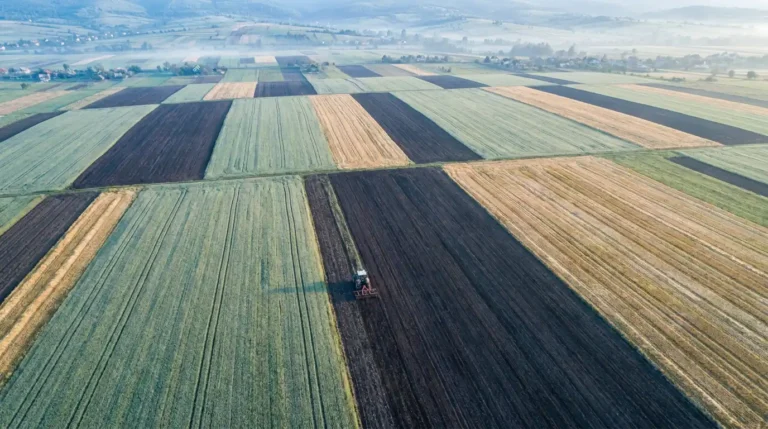
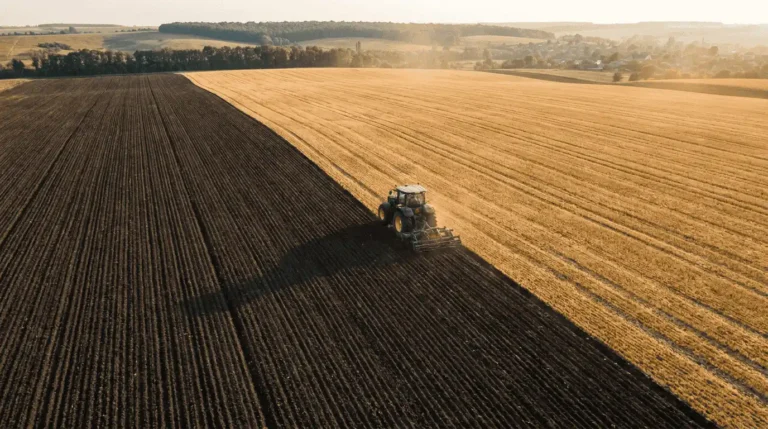
Short answer: in 2026 the full cost of deep loosening with your own machinery is 2,900 to 5,950 UAH/ha. The twofold difference depends not on the soil or the tractor but on how many hectares the machinery covers in a year. Below roughly 2,000 ha of annual workload a contractor is almost always cheaper. Below is a calculation for each component so you can plug in your own figures.
Most farms compare their own machinery with a contractor on a single figure — the cost of fuel. This is a mistake that costs hundreds of thousands of hryvnias a year: fuel accounts for only 35–45% of the real cost per hectare. The rest is wages, depreciation, repairs and the cost of money tied up in machinery.
What the cost of one hectare is made of
The cost per hectare is the sum of five components, and only two of them are visible “in the field”:
- Fuel and lubricants — visible straight away, everyone counts them.
- Operator wages — including the 22% social contribution and the off-season.
- Depreciation — writing off the value of the tractor and implement. Invisible, and the largest after fuel.
- Repairs, servicing, wear parts — points, tines, discs, bearings, filters.
- Cost of capital, insurance, storage — money “frozen” in machinery, plus insurance and a shed.
Components 1, 2 and 4 are variable: they grow in proportion to the area. Components 3 and 5 are fixed: they are the same on 500 ha and on 3,000 ha. That is why the same machinery can cost you 2,900 or 5,950 UAH per hectare.
How much fuel costs for each operation
Calculated at an average diesel price of 96.24 UAH/L (September 2026):
| Operation | Consumption, L/ha | Fuel cost, UAH/ha |
|---|---|---|
| Spraying | 1.5–3 | 145–290 |
| Mineral fertilizer application | 1.5–3 | 145–290 |
| Cultivation | 5–8 | 480–770 |
| Sowing cereals | 5–8 | 480–770 |
| Disking 8–12 cm | 7–10 | 675–960 |
| Harvesting cereals | 12–18 | 1,155–1,730 |
| Ploughing 20–25 cm | 16–26 | 1,540–2,500 |
| Deep loosening 30–40 cm | 18–25 | 1,730–2,405 |
The spread within an operation is not an error. The same plough uses 14–17 L/ha on sandy loam, but 23–26 L/ha on dried-out heavy chernozem at 25–27 cm. A worn engine and clogged filters add another 20–30%, while an experienced operator saves 10–15%. So on identical fields two farms can differ in fuel by up to 1,000 UAH/ha — with exactly the same machinery.
What an operator really costs
The average wage of a machine operator in Ukraine in September 2026 is 35,000 UAH a month (based on job listings; up 27% over the year). In the agricultural sector the average for tractor drivers is about 31,600 UAH, or 36,300 UAH with bonuses.
But for the cost per hectare, three things matter that are often forgotten:
- The 22% social contribution. 35,000 UAH “take-home” costs the employer ≈ 42,700 UAH/month, or 512,400 UAH a year.
- The off-season. The operator is paid for 12 months but works in the field for 5–7. In winter their wages still add to the cost per hectare.
- The rate depends on the operation. Market hourly rates in 2026: harvesting — 383 UAH/h, spraying — 320 UAH/h, sowing — 271 UAH/h, rolling — 142 UAH/h.
The key figure for comparison: one tractor driver on a large farm covers on average 3,700 ha a year. If your operator covers 800 ha, their hectare costs you 4.6 times more.
Depreciation: the figure you can’t see in the field
Let’s take a real set for deep tillage:
| Item | Cost |
|---|---|
| Tractor ~300 hp, used (similar to a John Deere 8335R) | ≈ $130,000 = 5,779,800 UAH |
| 4 m deep loosener | ≈ $45,000 = 2,000,700 UAH |
| Total investment | 7,780,500 UAH |
National Bank of Ukraine rate on 09.09.2026 — 44.46 UAH/$.
Now the fixed costs of this set per year, regardless of whether you worked 300 ha or 3,000:
| Item | UAH/year | How it was calculated |
|---|---|---|
| Depreciation | 622,440 | 80% of the value over 10 years (20% residual) |
| Operator wages incl. social contribution | 512,400 | 35,000 × 12 × 1.22 |
| Cost of capital | 466,830 | 10% a year on the average residual value |
| Insurance, storage, administration | 155,610 | 2% of the machinery value |
| Total fixed | 1,757,280 | — |
Variable costs per hectare of deep loosening at 35 cm: fuel 22 L/ha — 2,117 UAH, lubricants and filters — 169 UAH, wear parts (points) — 45 UAH, routine repairs — 105 UAH. Total 2,437 UAH/ha.
The full calculation: how area changes the price of a hectare
| Annual workload | Fixed, UAH/ha | Variable, UAH/ha | Cost, UAH/ha | $/ha |
|---|---|---|---|---|
| 500 ha | 3,515 | 2,437 | 5,950 | 134 |
| 1,000 ha | 1,757 | 2,437 | 4,194 | 94 |
| 1,500 ha | 1,172 | 2,437 | 3,609 | 81 |
| 2,000 ha | 879 | 2,437 | 3,316 | 75 |
| 3,000 ha | 586 | 2,437 | 3,023 | 68 |
| 3,700 ha | 475 | 2,437 | 2,912 | 65 |
That’s all the arithmetic behind the “own machinery or contractor” debate. The market rate for soil tillage services for deep loosening in 2026 holds at $60–80/ha. Compare with the “$/ha” column:
- Up to 1,500 ha a year — your own machinery costs more than a contractor, often 1.5–2 times more.
- 1,500–2,500 ha — the break-even zone; the decision depends on agronomic timing and contractor availability.
- Over 2,500–3,000 ha — your own machinery starts to win on cost.
What isn’t included in this calculation but still costs money
The 2,912–5,950 UAH/ha shown is an optimistic scenario. In reality you also need to add:
- Downtime due to breakdowns. A week of repairs during peak timing isn’t the cost of spare parts — it’s a shortfall in yield across the whole area.
- A second operator. One driver physically can’t sow 500 ha within the optimal 7–10 days.
- Logistics between fields. Moving a tractor between distant fields means fuel and hours without a single hectare worked.
- Loss of liquidity. 7.8 million UAH in machinery is money that didn’t go into fertilizers, seed or land rent.
- Obsolescence. After 8 years a tractor without section control and autosteer costs more to run than a new one at a contractor’s.
When your own machinery is still justified
The calculation doesn’t mean that owning a fleet is always a mistake. It is justified if:
- the annual workload of one implement consistently exceeds 2,500–3,000 ha;
- you provide services to others and fill the machinery’s schedule with other people’s fields;
- your fields are so scattered that a contractor physically can’t meet your agronomic deadlines;
- the operation is done 4–6 times a season (for example, spraying) — then the load on the implement is high even on a small area.
Note: agronomic timing is a separate cost item that the cost calculation doesn’t show. Delaying sowing by 5 days takes 7–10% of the yield, and in western Ukraine the work windows are narrower than the national average — details in the calendar of field work for the western regions.
And conversely: for operations done once a year on up to 1,500 ha — soil tillage, sowing, harvesting — your own machinery is almost always more expensive than a contractor.
How to calculate your own case in 10 minutes
A formula you only need to plug your figures into:
Cost, UAH/ha = (Annual fixed costs ÷ Annual workload, ha) + Variable costs, UAH/ha
- Calculate the annual fixed costs: (machinery value × 0.8 ÷ service life) + (wages × 12 × 1.22) + (machinery value × 0.6 × deposit or loan rate) + (machinery value × 0.02).
- Calculate the variable costs: (L/ha × diesel price) × 1.08 + wear parts + repairs.
- Take the actual workload of the implement over the past year — not the planned one.
- Compare with the contractor’s commercial offer with the same machinery and the same timing.
The main mistake at this step is comparing your own cost without depreciation with a contractor’s price that includes depreciation. Your own machinery always “wins” that comparison, and it’s always wrong.
Once the figure is calculated and the contractor is chosen, one thing remains: making sure the agreements are written down. That’s covered in the 14-point field work contract checklist. It’s also worth checking crop protection application rates separately: overlaps eat up 5–20% of the product budget, and that figure often exceeds the difference in the price of a hectare.
Frequently asked questions
How much does it cost to have one hectare worked by a contractor in 2026?
It depends on the operation: spraying — from $11/ha, disking — $25–35/ha, ploughing — $50–65/ha, deep loosening — $60–80/ha, harvesting cereals — $55–75/ha. The exact price depends on the area, type of work, region and distance to the field.
Why can a contractor be cheaper if they also build in a profit?
Because their machinery covers 3,000–5,000 ha a season instead of your 800. Fixed costs are spread over four times the area, and even with a margin the final price per hectare is lower than your own cost.
Should depreciation be counted if the machinery paid for itself long ago?
Yes. Even fully depreciated machinery has a residual value that you lose every year, and it will need replacing. Ignoring depreciation just pushes the cost into a future year rather than removing it.
What pays off better on 400–600 ha?
On such areas a fleet of powerful machinery practically never pays for itself: the cost per hectare comes out 1.5–2 times higher than a contractor’s market rate. The optimal model is turnkey field management or contracting out the most expensive operations.
How do you check whether a contractor's price is fair?
Calculate their variable costs: fuel consumption × diesel price + 8% for lubricants. If the contractor’s price is below this sum, they are either working at a loss or will cut corners on depth, speed or quality. A healthy rate is 1.4–1.8 times the cost of fuel and lubricants.
We’ll calculate your figure
WESTER carries out the full cycle of field work — soil tillage, sowing, fertilizer application, spraying and harvesting — with our own fleet of Bednar, Kello-Bilt, Massey Ferguson and Pöttinger machinery in 9 regions of western and central Ukraine.
Tell us your area, type of work and location — we’ll calculate the cost of your hectare and show where you’re currently overpaying.