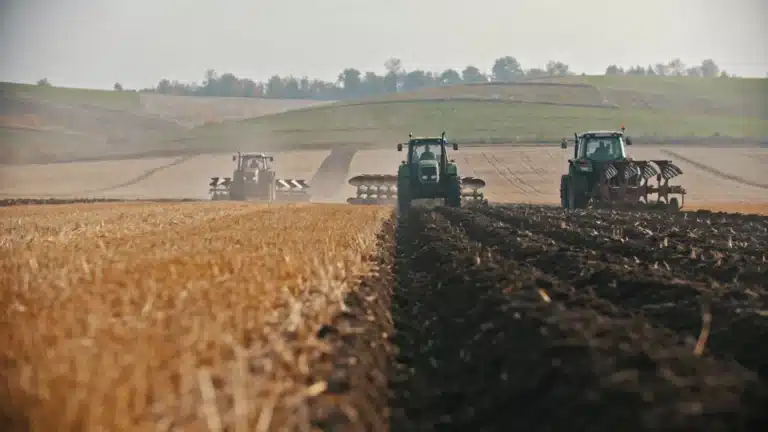
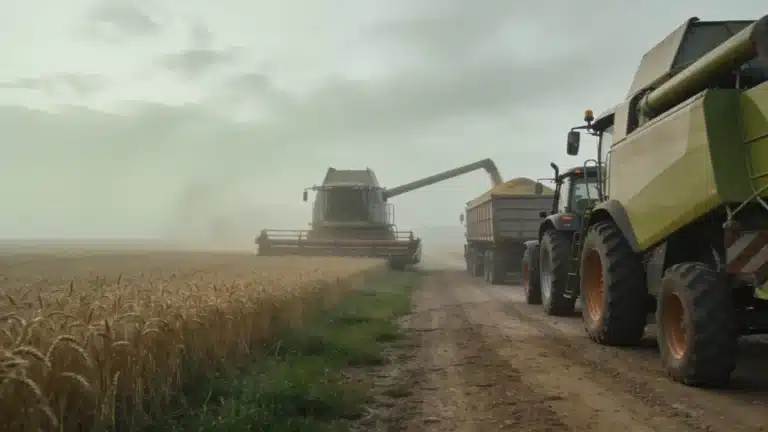
July is the month when the same scene repeats every day in the fields of the Khmelnytskyi, Rivne, Vinnytsia and Ternopil regions. The agronomist goes out into the field, rubs an ear in their palm, looks at the sky and thinks: today, or wait another day? It seems like a small thing. In reality a week of delay can eat up 10–15% of the yield — through shattering and lodging.
Wheat harvest is the moment of the season when the decision “today or tomorrow” determines the financial result of the whole year. We won’t retell an agronomy textbook. We’ll tell you how we ourselves decide when to send the combine into the field. We go by grain moisture and take into account why a late harvest costs more than it seems. And we’ll explain how we match machinery to a specific field, not the other way round.
Moisture — that’s what really matters
Direct combining of wheat is possible at full ripeness, when grain moisture doesn’t exceed about 17%. Above this limit the thresher starts crushing the grain rather than threshing it cleanly, and losses grow before your eyes.
Two different figures should be distinguished here. The base standard under DSTU 3768 for commercial wheat grain is moisture up to 14%. That’s about the quality of a batch for sale, not about whether combining is possible as such. The difference between 17% and 14% isn’t a bureaucratic detail. Every extra percentage point of moisture means extra money for drying at the elevator, and the farm gets the bill. Seed material should be considered separately: here the critical moisture is 14.5–15.5%. It should be stored a few percentage points lower, otherwise the risk of microbial damage in storage rises sharply.
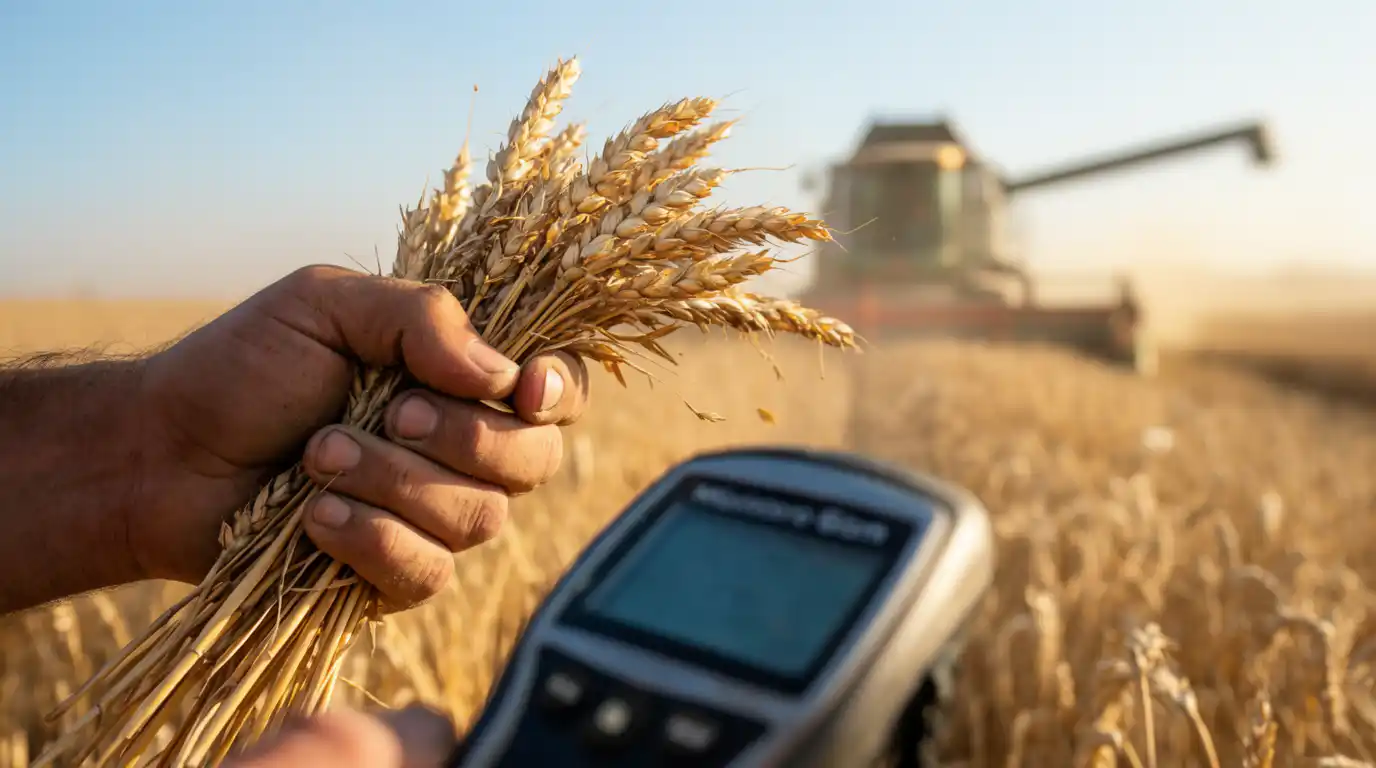
To be honest, we forgot about the calendar about five years ago. A moisture meter — and that’s all you need
Why delaying the harvest is expensive
A wheat harvest stretched out by an extra week costs more than it seems at first glance. Wheat left standing too long shatters. The ears dry out, and some of the grain ends up on the ground before the header reaches it. A delay of 7–10 days after full ripeness is costly. On our fields in Podillia and Volyn it usually means grain losses of 8–12%. With strong wind or rain the figure grows even more — it all depends on the particular season.
The second scenario, which we see more often than we’d like: stems lodging after rain and wind. The wheat lies down on the ground, and the combine’s working speed on such a field drops by half or even two thirds. The header simply can’t lift ears lying across the rows. And if wet weather lasts more than a few days, the grain can start sprouting right in the ear. Then selling it as milling wheat is out of the question.
Machinery should match the field, not the other way round — and these aren’t just fine words
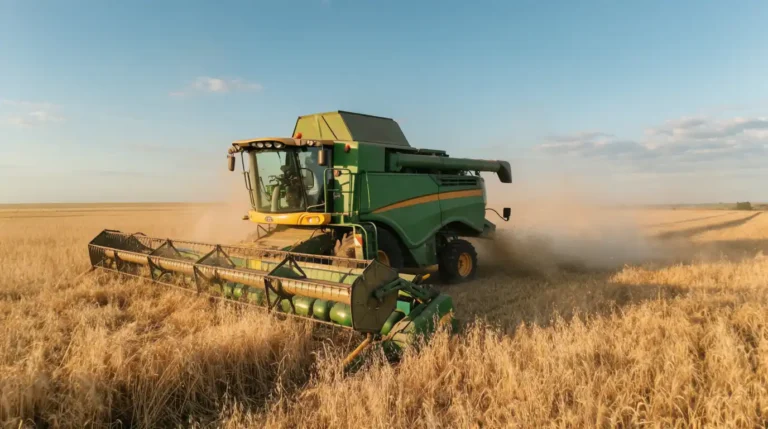
On large fields from 100 ha a wide header of 9–12 metres makes sense. On smaller or irregularly shaped plots more compact machinery of 6–7 metres works better. Here manoeuvrability matters more than the width per pass. Thresher capacity determines how many hectares can really be covered in a day before the weather changes. And on lodged or uneven fields what matters much more is not engine power but steady pick-up of the ears. Modern self-propelled combines also have grain loss sensors. They let you adjust the travel speed during work without stopping.
Trailed combines are hardly ever seen in commercial farming today — perhaps only on small household plots. For farms of several hundred hectares or more, only a self-propelled machine makes economic sense: output is higher and there’s less downtime on turns.
You can view the list of our combines
What to check before the combine enters the field
The condition of access roads and headlands — especially after rain, when heavy machinery really risks getting stuck at the entrance. Having transport to haul the grain away is also critical. The combine stands idle if there’s nowhere to unload the grain tank, and that’s a direct loss of time on the hottest days of harvest. Just as important is whether the grain yard or elevator is ready to accept grain with higher moisture if you have to combine closer to 17%. And separately — a technical inspection of the header and thresher itself: worn knives and sieves are one of those hidden causes of grain loss. You can’t see it with the naked eye until you count how much is left in the field.
We plan the trip so that the combine, the grain transport and, if needed, a straw baler work in the field at the same time — this removes downtime and significantly shortens the overall time to finish the field.

Wheat harvest by region: how the timing differs
In the Khmelnytskyi region and Podillia the winter wheat harvest usually starts in the second half of July. In the Rivne region, because of a somewhat different climate and wetter soils, the window often shifts a few days later. In the Ternopil region, though, the weather changes quickly at this time. That’s why we don’t go by the calendar date at all — only by daily moisture checks. This makes it easier to avoid machinery standing idle waiting for the “perfect” day, which may never come.
One modern self-propelled combine with a 9-metre header covers 100 ha in 1.5–2 days in good weather. On lodged or uneven plots this time doubles. If the forecast promises prolonged rain, it sometimes makes more sense to start combining earlier — with moisture closer to the upper limit. The grain can then be dried at the grain yard or elevator. That’s cheaper than losing part of the crop to lodging and shattering. And yes, you can order a combine for just a few days of harvest. For most farms, keeping their own fleet for two peak weeks a year simply doesn’t pay.
Wheat harvest is an operation where the decision “today or tomorrow” determines the financial result of the whole season. Go by grain moisture, not just the calendar, and match the combine to the real condition of the field.
Need a combine for the harvest in the Khmelnytskyi, Rivne, Vinnytsia or Ternopil region?
Call us +38(066)-908-80-80 — we’ll match machinery to your field and timing.